I am by no means a mathematical expert, but in the course of my job I am often steeped in the concepts and techniques that I was once instructed in, many moons ago. At least, the concepts are the same: many of the techniques seem to have been altered or, in some cases, abandoned. I once received many an uncomprehending stare when I referenced the FOIL method of multiplying binomials; I consider it perfectly intuitive, but evidently today’s algebra teachers think that it’s too difficult for kids to remember.
One thing that surprises me year after year, though, is the lack of confidence or competence that kids (and adults) have in performing long division. After all, division is one of the four fundamental operations in arithmetic, something that students are supposed to have mastered a long time before I ever meet them. Yes, I know the majority of high school students have not actually mastered any of the operations, but I can occasionally coax a kid into at least attempting to calculate 5+12 without using a calculator. I am not certain when I last saw a student tackle a division problem without letting a computer do it for them.
And long division is, after all, just division. When applied to larger numbers (say three or more digits) it essentially consists of dividing the number a little bit at a time, biting off the leftmost digits one at a time until you’ve chewed through the whole candy bar. Here’s an illustration of 12345÷5 that I just busted out on a whiteboard:
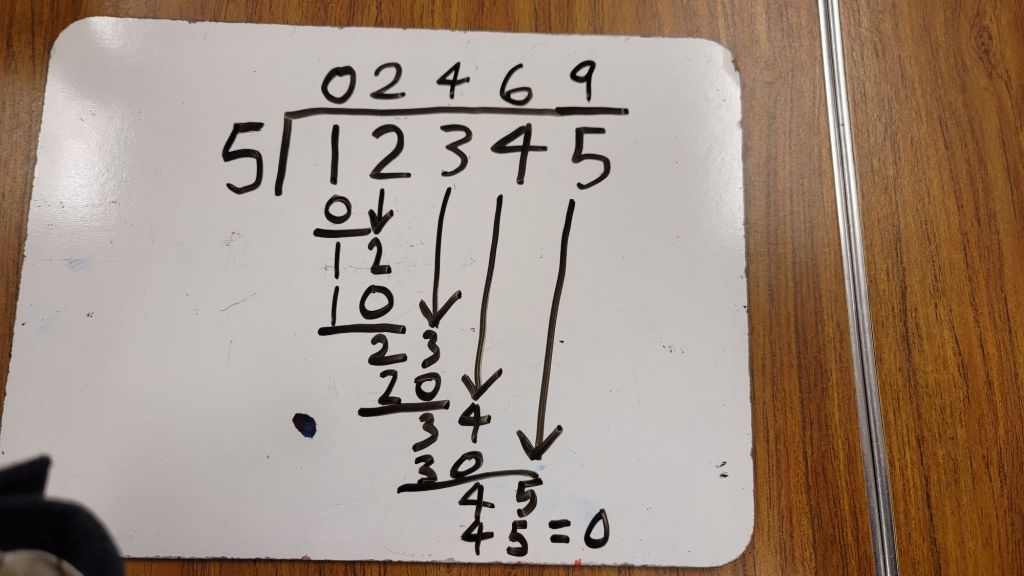
As you can see in the picture, the answer to that problem is 2469. That is to say, 12345÷5=2469, which is the same as saying 2469×5=12345. I often feel the need to remind my students that multiplication and division are inverses of one another, so simple division can be performed by doing multiplication backwards. This insight is probably most useful for those students who know their times tables, but really, they are all supposed to know their times tables. Don’t let that be an excuse!
Anyway, you can see the steps laid out very cleanly in the picture. Since 5 is greater than 1, it obviously cannot “go into” it, as they say in elementary school. So the first digit of the answer is 0, which of course we wouldn’t actually write as our first digit unless it were immediately followed by a decimal point. If I weren’t writing a comprehensive remedial lesson in the process then I would probably just skip this step. But I am, so I won’t.
Multiply 5 by 0, and you get 0. Subtracting this 0 from the original 1 leaves us with 1 (naturally). Having thus processed the first digit of 12345, it is time to move onto the second, and pull the 2 down to join the 1, forming 12. Since 12 is larger than 5, then we know that 5 can “go into” it at least once, and in fact we know it can go into it twice (because 5×2=10) but not thrice (because 5×3=15, and 15 is more than 12). So the first real digit of our answer is 2.
We then multiply 5 by 2, to get 10, and subtract that 10 from the 12 we made earlier. 12-10=2, so processing the second digit has left us with 2. It is now time to repeat the process for the third digit, and for as many digits as we have left, like so:
Bringing down the 3 gives us 23. 5×4=20, so the second digit of our answer is 4, and 23-20=3.
Bringing down the 4 gives us 34. 5×6=30, so the third digit of our answer is 6, and 34-30=4.
Bringing down the 5 gives us 45. 5×9=45, so the fourth digit of our answer is 9. Since 45-45=0, and we have no further digits to bring down, then 9 must also be the final digit of the answer.
Of course, if our last act of subtraction had not left us with zero, we would have had to do more work. Fortunately, the work would have been easy: we would add a decimal point to the end of both our answer and the original number, and start bringing down zeroes. We would continue to repeat the steps and bring down zeroes until subtraction finally yields zero, or else it becomes apparent that we are trapped in an infinite loop.
It should also be noted that, if any of our subtractions had produced a number larger than 5, it would have indicated an error, since we had not correctly identified the closest multiple of 5. But if you know your times tables (and again, it is very important to know your times tables) that should not happen too often.
Are we all good on how long division works now? I take your silence to be an affirmation. Excellent. The rest of this will make a little more sense.
In my spare moments at work, when I need something to do with my hands and brain, but I don’t have a puzzle handy, I will sometimes write myself a long division problem. It’s a satisfying task, with a defined procedure and a clear objective. I also enjoy the visual aspect of writing out the numbers and working through them as they take up space on the paper; I think the increasingly long descending lines look like the strings of a grand piano. But to really get the grand piano effect, you need to start out with a really long number—88 digits probably wouldn’t fit comfortably on the page, but imagine the grandeur!
It happened the other day that I was trying to think of a very long number to divide, and I settled on an interesting way to generate it. I simply chained together powers of two, so that the sequence 2, 4, 8, 16… became 24816… and so on. I kept doubling as much as I dared, with the idea that I would continue until every digit from 0-9 was represented at least once.
However, by the time I tacked on my 12th power of 2, I was beginning to run out of space. My number was now a staggering 248163264128256512102420484096, which notably includes every digit except for one: 7. Now, to keep me occupied for the longest possible time, I wanted a divisor that seemed likely to lead to a decimal point answer: it seemed to me that 7, being big (for a single digit number anyway) and odd, was as good a choice as any.
So I started dividing, and dividing, and dividing some more. It obviously took me a bit longer to calculate 248163264128256512102420484096÷7 than it did to calculate 12345÷5, but I want to stress that it wasn’t actually any harder. The only real sticking point was writing smaller and smaller to accommodate the increasingly elongated lines I was drawing to bring digits down. Eventually, I had to compromise that lovely piano shape, but I kept going, taking each new digit just like the one before.
And then, unexpectedly, I came to the end. Somehow, it turned out that 248163264128256512102420484096÷7 was equal to 35451894875465216014631497728. That is to say, the arbitrarily long chain of digits I had selected, itself containing no instances of the digit 7, was somehow evenly divisible by 7. Who knew?
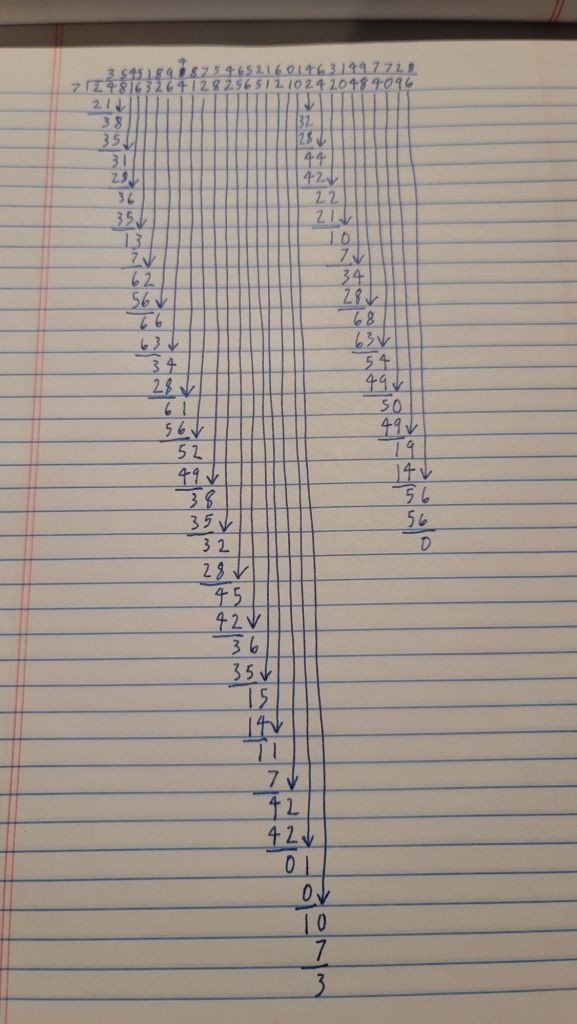
Was this sheer coincidence, or had I chanced in my amateurish doodling upon some truly fascinating property of numbers? Could I reproduce this outcome with another starting value? Could it be that any number composed of a sequence of 12 powers strung together must also be a multiple of seven? Probably not, but there was only one way to find out.
The next day, I started building a new number. This time I based it on powers of 3, such that the sequence 3, 9, 27, 81… became 392781… and so on. This developed, by the inclusion of the 12th power of 3, into the gargantuan number 392781243729218765611968359049177147531441.
If you look carefully you’ll find that, unlike the last one, this beast of a figure contains at least one of all the digits 0-9. Perhaps that’s just probability at work, as there are more digits involved; I don’t know, I’m not a mathematical expert. All I knew was that I wanted to take this number and divide it by 7, so that’s what I did.
Thus, in my quest to discover a fascinating property of numbers via idleness and dumb luck, I succeeded in discovering that 392781243729218765611968359049177147531441 is not, in fact, evenly divisible by 7. The value of 392781243729218765611968359049177147531441÷7 is actually 56111606247031252230281194149882439661634.571428 (repeating). My conjecture must therefore be consigned to the ash heap of history, unmentioned by any reputable mathematical texts. The level of seriousness required by this experiment demands no less.

 Ink Tea Stone Leaf
Leave a comment