Welcome back to my weekly series, Vocab 128, in which I sit down with pen and paper and write 128 words beginning with the same letter, in more or less the order that I think of them, before scanning the page and posting it here. The result is a flex of my vocabulary muscles, an exposure of my handwriting to the world, and perhaps an insight into the psychology of my word associations.
Generally, I avoid words that are merely alternate forms of other words, and when I think of such a word I generally default to the appropriate noun form. Proper nouns I exclude as a rule (but we’ll see how that goes once I get to… oh damn, X is next week).
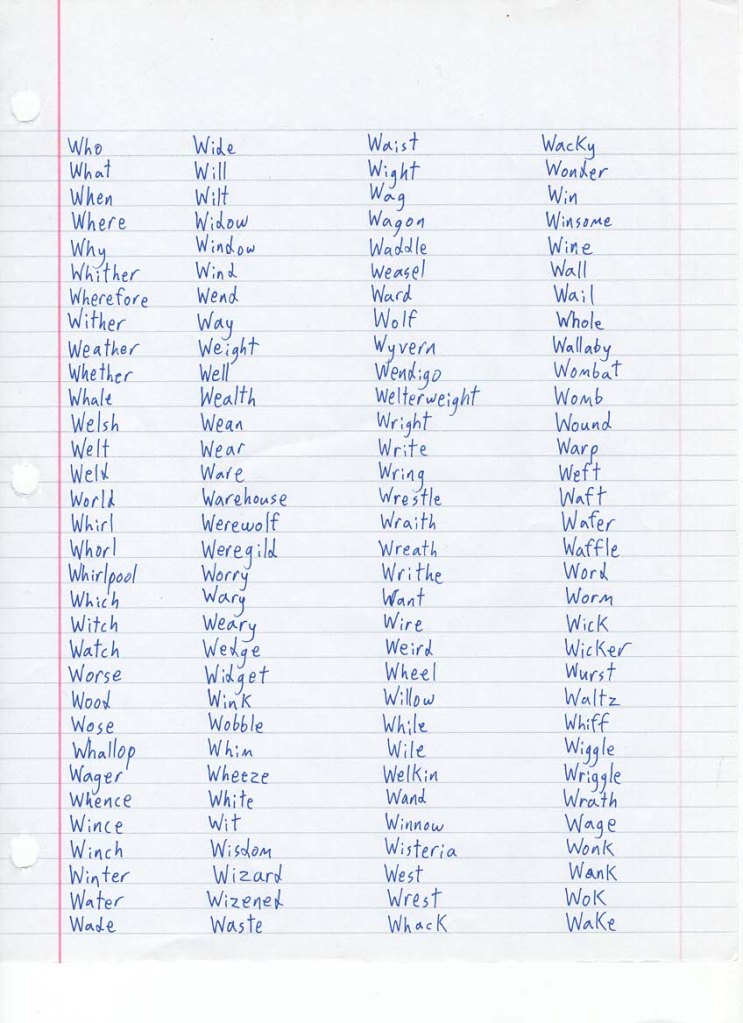
W, it turns out, is way easier to work with than U or V. There were a lot of solid words left on the table, like “wrench,” “woad,” “work,” “with,” and “woe.” I used two of those alone in the first sentence of this paragraph!
The verb “to wind” is one of the most vexing in the language for me. Its present tense form is spelled the same as “wind,” as in the movement of air, but is pronounced differently; meanwhile its past tense form is spelled the same as “wound,” as in an injury to flesh, but also pronounced differently. Therefore, the question of whether any form of the verb “to wind” appears on this list is perfectly ambiguous, but it would not be ambiguous if I were to to read it out loud. Vexing.
I may, perhaps, have overstepped propriety by including “wose,” short for “woodwose,” a name by which the mythical wild man of the woods is known. Its presence is all the odder for the fact that I evidently forgot to include the word “wild.” In fairness, Tolkien used the word “woses” for such people and I often follow his lead unquestioningly.
When a person reads a whole lot of Shakespeare in the course of a year, words like “welkin” are bound to pop up. It’s probably one of my favorite words I’ve learned this year.
“Wallop” evidently does not contain an H. I regret the error.
This week’s definition from American Heritage Dictionary:
wring (rĭng)
tr.v. wrung (rŭng), wring·ing, wrings
1.
a. To twist, squeeze, or compress, especially so as to extract liquid. Often used with out: wring out a wet towel.
b. To extract (liquid) by twisting or compressing. Often used with out: wrung the water out of my bathing suit.
2. To wrench or twist forcibly or painfully: wring the neck of a chicken.
3.
a. To clasp and twist or squeeze (one’s hands), as in distress.
b. To clasp firmly and shake (another’s hand), as in congratulation.
4. To cause distress to; affect with painful emotion: a tale that wrings the heart.
5. To obtain or extract by applying force or pressure: wrung the truth out of the recalcitrant witness.
n.
The act or an instance of wringing.
[Middle English wringen, from Old English wringan; see wer-2 in the Appendix of Indo-European roots.]

 Ink Tea Stone Leaf
Leave a comment