Welcome back to my weekly series, Vocab 128, in which I sit down with pen and paper and write 128 words beginning with the same letter, in more or less the order that I think of them, before scanning the page and posting it here. The result is a flex of my vocabulary muscles, an exposure of my handwriting to the world, and perhaps an insight into the psychology of my word associations.
Generally, I avoid words that are merely alternate forms of other words, and when I think of such a word I generally default to the appropriate noun form. Proper nouns I exclude as a rule (but we’ll see how that goes once I get to X).
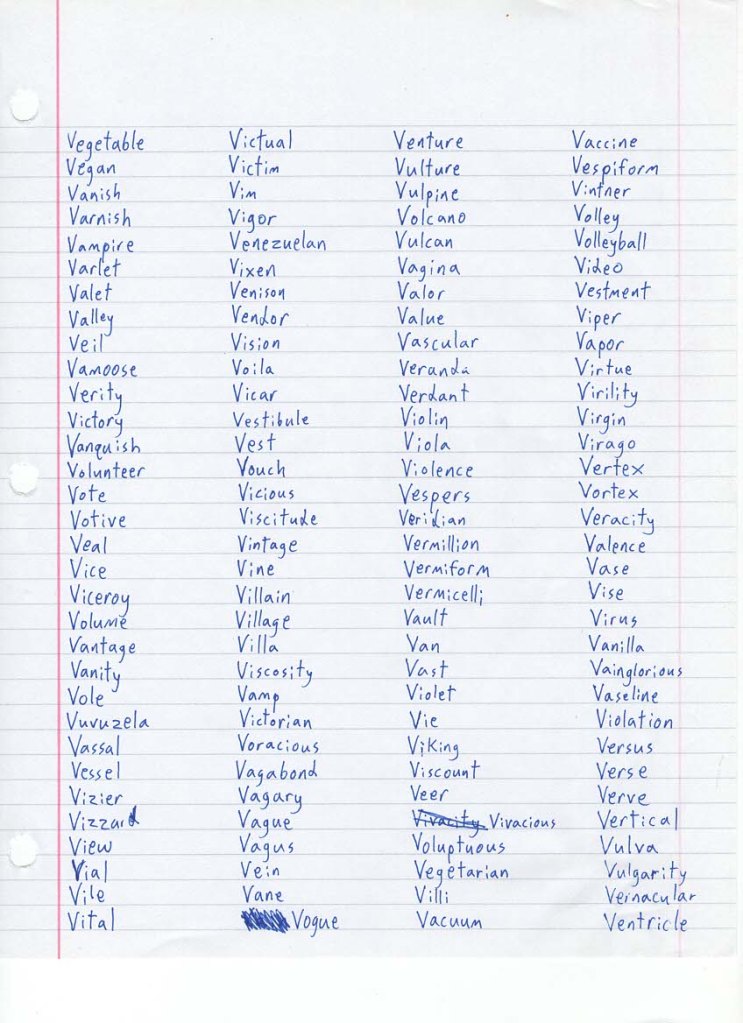
V was, alas, something of a disaster. It did not take a terribly long time to get to 128, but too many foolish errors and digressions took place along the way.
I initially included the word “vain,” before realizing that I had already included the related form “vanity;” therefore I scribbled it out and replaced it with “vogue.” Likewise, I wrote the word “vivacity” and panicked over whether it was actually a correct form; it is, but I replaced it with the safer “vivacious.”
There is no AHD entry for “vespiform,” although there is one for “vespine,” the word that I was trying to come up with. I confused it in my mind with “vespene,” a fictional gas from the StarCraft video games, and I did not think that would count.
The biggest disaster on this list is “viscitude,” a word that does not exist. I meant to put “vicissitude,” which would have been really great, and I cocked it up real bad. There is a word “viscidity,” but I don’t know that word.
“Vizard” only has one Z, and some people prefer the spelling “visard,” but Shakespeare’s spelling has a Z and I’ll go with that. Odd that I came up with that and not “visor.”
Etymologically speaking, “vague” and “vagary” are a little too close for comfort, as are “vertex” and “vertical.” “Vamp” is 100% separate from “vampire,” however, and you can look it up if you want.
“Vaseline” is a brand name, yes, but it has “kleenex” status.
Words I most wish I had remembered before I finished (and replaced some of these embarrassments): “vehicle,” “vanguard,” either “vermin” or “varmint,” and “venereal.”
This week’s definition from American Heritage Dictionary:
vict·ual (vĭtl)
n.
1. Food fit for human consumption.
2. victuals Food supplies; provisions.
v. vict·ualed, vict·ual·ing, vict·uals or vict·ualled or vict·ual·ling
v.tr.
To provide with food.
v.intr.
1. To lay in food supplies.
2. To eat.
[Alteration (influenced by Late Latin vīctuālia, provisions) of Middle English vitaille, from Old French, from Late Latin vīctuālia, provisions, from neuter pl. of Latin vīctuālis, of nourishment, from vīctus, nourishment, from past participle of vīvere, to live; see gwei- in the Appendix of Indo-European roots.]
Usage Note: Victual is properly pronounced (vĭtl), with two syllables and no (k) sound. It was borrowed in the 1300s from the Old French form vitaille, which had stress and a diphthong in the second syllable, but the word was Anglicized after that to put the stress up front in the manner of most native English words. The spelling with c (and a little later with u) has a long history too, in both French and English. This spelling is a learned one, showing off the knowledge that the word came from Late Latin victuālia, “provisions.” The word is now usually spelled victual, or on occasion vittle, but the pronunciation has remained (vĭtl).

 Ink Tea Stone Leaf
Leave a comment