Welcome back to my weekly series, Vocab 128, in which I sit down with pen and paper and write 128 words beginning with the same letter, in more or less the order that I think of them, before scanning the page and posting it here. The result is a flex of my vocabulary muscles, an exposure of my handwriting to the world, and perhaps an insight into the psychology of my word associations.
Generally, I avoid words that are merely alternate forms of other words, and when I think of such a word I generally default to the appropriate noun form. Proper nouns I exclude as a rule (but we’ll see how that goes once I get to X).
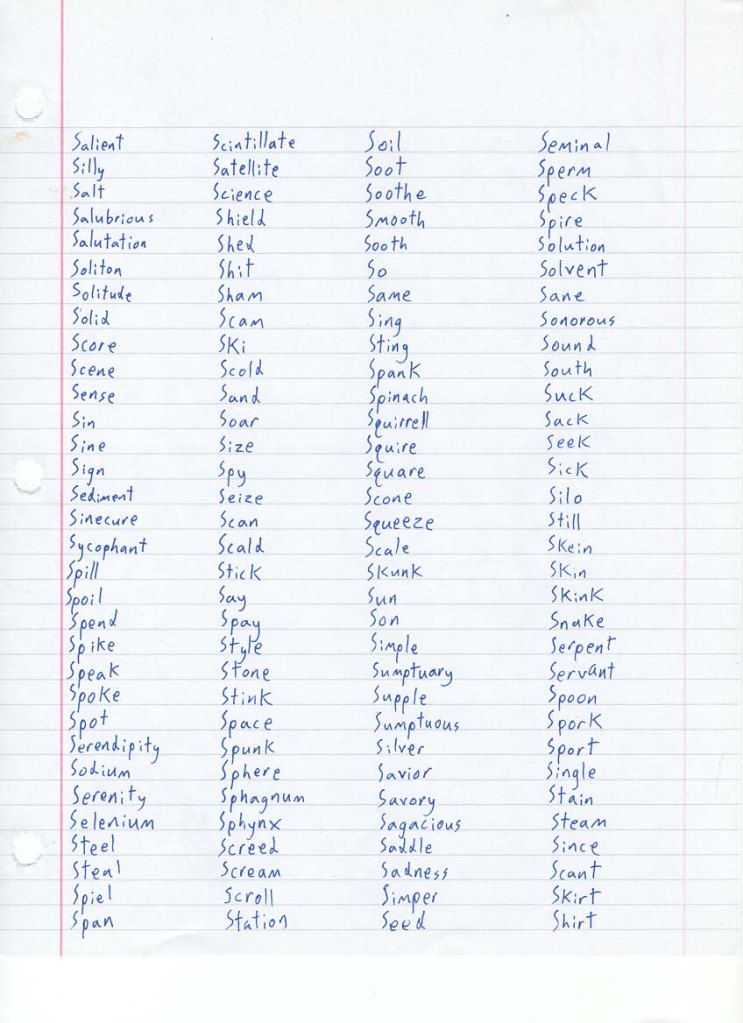
One of my favorite bits of etymological trivia is that a single root in the Proto-Indo-European language, *skei- (the asterisk indicates that this is a reconstructed root, since PIE is not attested by any written documents and its vocabulary has to be inferred by studying its descendant languages), is the ancestor of both the English verbs “shed” and “shit,” the common idea being of separation (such as from a body). There was a general tendency for Old English words beginning in SC to change to SH by the Middle Ages, such that words like sceadan and scitan (both pronounced with hard C’s originally) became more like the words we know and love today. Meanwhile, medieval English was borrowing words from Latin which also began with SC and in fact derived from the very same PIE root, among which is “science,” which comes from the verb scire (also originally pronounced with a hard C), which means “to know,” such as by distinguishing (or separating) one thing from another. Consult the Online Etymological Dictionary to discover all of the many incredible words that have proliferated from *skei- over the last six thousand years or so.
“Shirt” and “skirt” do not come from that same root, but they are also etymological doubles. The old English word was scyrte, which became shirte in Middle English by the same C to H process that affected “shed.” During the same span of time, however, the word skyrta was borrowed from Old Norse, and did not undergo the same sound change. The meaning of words for various garments often changes over time; both of these words probably referred originally to a long shirt.
I can never recall how many R’s and L’s the word “squirrel” has, so I often err in giving it two of both. This word simply has too many letters.
However, I am very proud of myself for giving “satellite” the correct number of T’s and L’s. I almost never do on the first try, but here we are!
This week’s definition from American Heritage Dictionary:
si·ne·cure (sīnĭ-kyr′, sĭnĭ-)
n.
1. A position or office that requires little or no work but provides a salary.
2. Archaic An ecclesiastical benefice not attached to the spiritual duties of a parish.
[From Medieval Latin (beneficium) sine cūrā, (benefice) without cure (of souls) : Latin sine, without + Latin cūrā, ablative of cūra, care; see CURE.]

 Ink Tea Stone Leaf
Leave a comment