Welcome back to my weekly series, Vocab 128, in which I sit down with pen and paper and write 128 words beginning with the same letter, in more or less the order that I think of them, before scanning the page and posting it here. The result is a flex of my vocabulary muscles, an exposure of my handwriting to the world, and perhaps an insight into the psychology of my word associations.
Generally, I avoid words that are merely alternate forms of other words, and when I think of such a word I generally default to the appropriate noun form. Proper nouns I exclude as a rule (but we’ll see how that goes once I get to X).
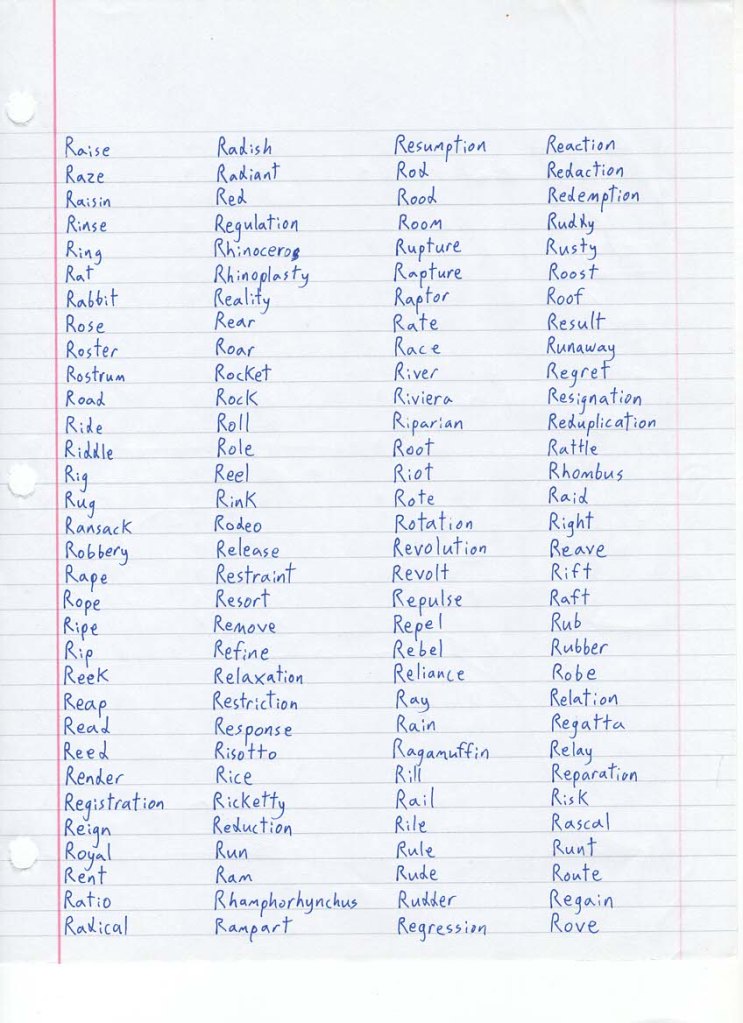
R was pretty easy, as you might guess. The only real difficulty I had was in deciding whether a word with the “re-” prefix was sufficiently a word in its own right to merit inclusion without shame. There is no real answer to that question and it doesn’t matter at all, but all I can say is that I feel better about “restraint” than I would have about “rewrite.” “Rewrite” is a perfectly cromulent word, but it would have felt like cheating.
This is the second list in a row to include the name of a pterosaur, “rhamphorhynchus,” following last week’s “quetzalcoatlus.” If only I had included “pterosaur” on the P list (or even “pterodactyl”), I’d have a hat trick.
I added an extra T to “rickety.” I knew I should have just written “rickets.”
I’ve thought of so many good R words since I started crafting this post (“rodent,” “rustic,” “reification,” “ratite,” “rump,” “revenge,” “ravine,” “ratatouille,” “retrograde,”) that 128 almost seems like too low a number for this sort of exercise. When I start thinking like that, please remind me of Q, and I will be at peace.
This week’s definition from American Heritage Dictionary:
rood (rd)
n.
1.
a. Archaic The cross on which Jesus was crucified.
b. A crucifix, especially one surmounting the rood screen or rood beam of a medieval church.
2. Chiefly British A measure of length that varies from 5 1/2 to 8 yards (5.0 to 7.3 meters).
3. A measure of land equal to 1/4 acre, or 40 square rods (0.10 hectare).
[Middle English, from Old English rōd.]

 Ink Tea Stone Leaf
Leave a comment