Welcome back to my weekly series, Vocab 128, in which I sit down with pen and paper and write 128 words beginning with the same letter, in more or less the order that I think of them, before scanning the page and posting it here. The result is a flex of my vocabulary muscles, an exposure of my handwriting to the world, and perhaps an insight into the psychology of my word associations.
Generally, I avoid words that are merely alternate forms of other words, and when I think of such a word I generally default to the appropriate noun form. Proper nouns I exclude as a rule (but we’ll see how that goes once I get to X).
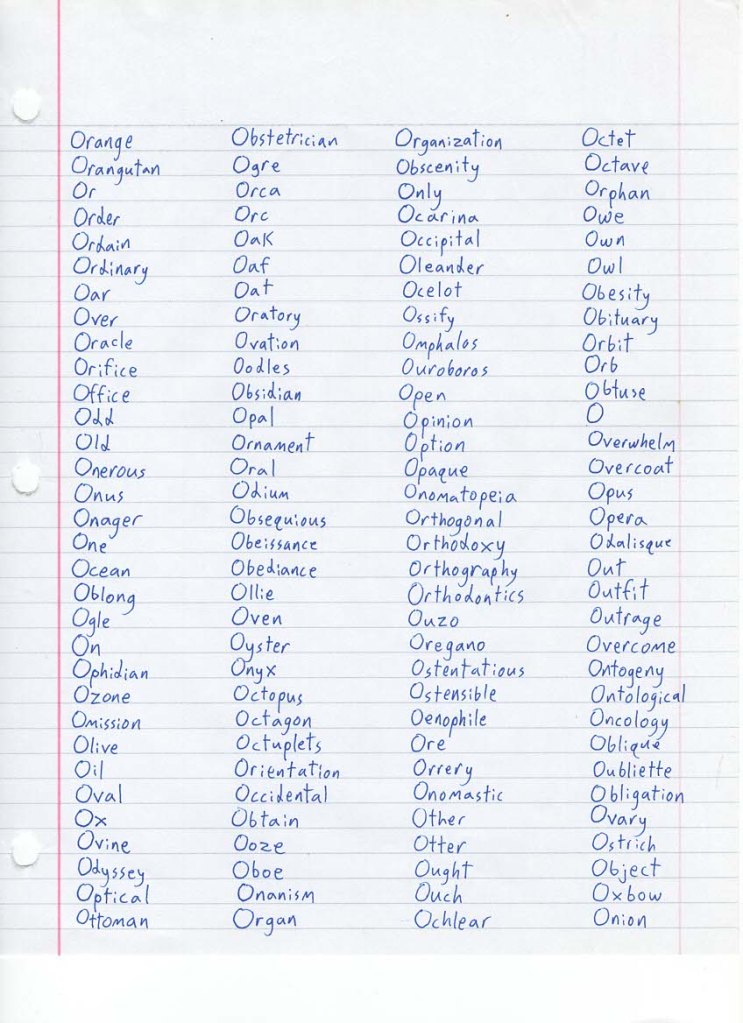
Let us begin with the elephant in the room: there is no such word as “ochlear,” or rather, “ochlear” doesn’t mean anything. I misremembered the word “cochlear.” Shame on my house for a thousand generations.
Etymologically, “opus” and “opera” are the same word. In Latin, opus is a “work,” and opera is the plural “works.” But in English, as in other modern languages, an opera is a particular kind of singular work, and possesses its own plural “operas.” They have become truly separate in this way. Ain’t language fun?
“O” is probably the most obscure of the (very) small class of words that are spelled with only one letter, are not abbreviations, and are not considered slang or nonstandard. As a matter of fact, I think its only fellow members are “A” and “I.” Though it pained me, I resisted the urge to include “oh” as well and invite controversy from people who use them interchangeably.
I added an extra S to “obeisance,” it just seemed like it needed one. It didn’t, though.
“Oenophile” reminded me that there are some words which, were I educated in a different orthographic tradition, I might have included, like “oesophagus” and “oestrogen.” But I have not abandoned my roots. Still, as my mistake with “ochlear” means that I have only managed 127 words this week, I submit this replacement: “oedipal.”
This week’s definition from American Heritage Dictionary:
on·a·ger (ŏnə-jər)
n.
1. A wild ass (Equus hemionus) of Asia, having an erect mane, a light brown coat, and a dark stripe along the back.
2. An ancient and medieval catapult, often employing a wooden arm with a short sling.
[Middle English, from Late Latin, from Latin, wild ass, from Greek onagros : onos, ass; see ASININE + agrios, wild; see agro- in the Appendix of Indo-European roots.]

 Ink Tea Stone Leaf
Leave a comment