Welcome back to my weekly series, Vocab 128, in which I sit down with pen and paper and write 128 words beginning with the same letter, in more or less the order that I think of them, before scanning the page and posting it here. The result is a flex of my vocabulary muscles, an exposure of my handwriting to the world, and perhaps an insight into the psychology of my word associations.
Generally, I avoid words that are merely alternate forms of other words, and when I think of such a word I generally default to the appropriate noun form. Proper nouns I exclude as a rule (but we’ll see how that goes once I get to X).
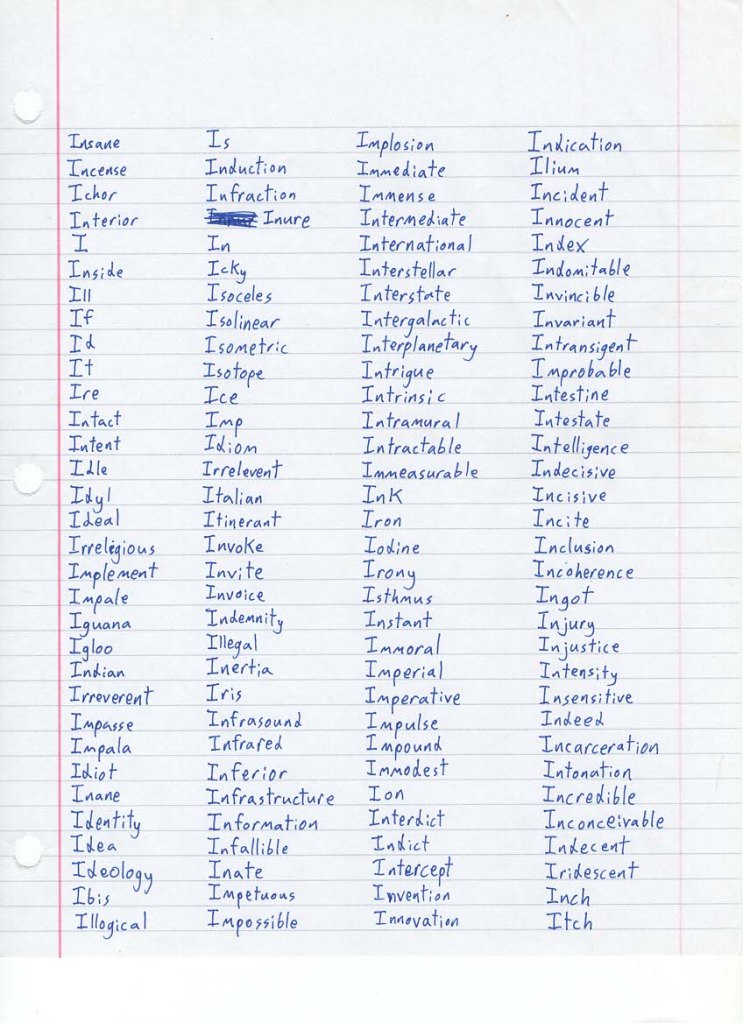
If “in” and “inside” are simply too close to being the same word, then just pretend I wrote “inn” instead of “in.” Damn, I can’t believe I couldn’t come up with “instead.”
The word “incest” popped into my head while I was gathering pen and paper, and then I simply forgot to write it down. The same goes for “insect.” The problem, I say, is that so many of these “I” words sound the same.
This week’s definition from American Heritage Dictionary:
in·ter·dict (ĭn′tər-dĭkt)
tr.v. in·ter·dict·ed, in·ter·dict·ing, in·ter·dicts
1. To prohibit (an action or thing) or forbid (someone) to do something, especially by legal or ecclesiastical order.
2.
a. To cut or destroy (a line of communication) by firepower so as to halt an enemy’s advance.
b. To confront and halt the activities, advance, or entry of: “the role of the FBI in interdicting spies attempting to pass US secrets to the Soviet Union”(Christian Science Monitor).
n. (ĭntər-dĭkt′)
1. An authoritative prohibition, especially by court order.
2. Roman Catholic Church An ecclesiastical censure that bars an individual, members of a given group, or inhabitants of a given district from participation in most sacraments.
[Alteration of Middle English enterditen, to place under a church ban, from Old French entredit, past participle of entredire, to forbid, from Latin interdīcere, interdict- : inter-, inter- + dīcere, to say; see deik- in the Appendix of Indo-European roots.]

 Ink Tea Stone Leaf
Leave a comment