I want to talk about my favorite moment from the new Superman movie. Yes, I saw the new Superman movie; perhaps you’re thinking, “of course you saw the new Superman movie, this is exactly the sort of movie you go to see.” There’s something to that, as I am a huge nerd. I was always much more into Marvel than DC, though I like Superman and I know quite a bit of his lore. But I haven’t been to see a superhero movie in the theaters since Avengers: Endgame*, a movie that did perhaps too good a job of convincing me that the era of the superhero movie was over. I’m not an especially frequent theater patron anyway, so it was hardly a guarantee that I would turn out for the latest from the last son of Krypton.
*OK, I went to see Across the Spider-Verse. But that’s a different kind of movie, you know?
I will admit, the meta-narrative around Superman had something to do with getting me out the door. Superman, a film by James Gunn (who makes very good and fun superhero movies), managed to piss off all the right people by framing its story around the hero’s alien origins, his compassion for oppressed and marginalized people, and the manipulation of the social media environment by a prickly, delusional, self-centered billionaire who thinks he’s a very special genius because he’s surrounded by sycophants. The right wing media folks in the real world spun a whole lot of outrage about how Superman was woke, and how we’re all stupid and brainwashed for thinking that the well-known story of Kal-El, who arrived on Earth as a child without documentation and has a social security number under the name “Clark Kent,” is in any way analogous to the experiences of all the children they would like to summarily deport to countries they have ever known. I mean, you’d have to be a world class idiot to think that there was any meaningful resemblance, right?
A brief aside, if you’ll forgive me—can I just say once again how grotesque it is that right-wing people have adopted the word “woke” as an all-purpose epithet? The use of “woke” as an adjective meaning “aware of the prevailing racial prejudice and on guard against it” is very old in African-American Vernacular English, with citations to that effect from across the 20th century. That it has now been taken up with a sneer as a cudgel by white people who take great offense at the notion of tolerating diversity (to say nothing of encouraging it) is…. well, I already said the word. It’s grotesque, like the kind of thing you could imagine a literal gargoyle saying while dirty water gushed out of its mouth.
So I went to go see “woke Superman” for three reasons: I thought it would be really fun; I wanted to add a few dollars to its gargantuan box office gross, thus validating the investment of a mega-corporation attempting to capitalize on my affection for its intellectual property and my desire to see somebody (anybody) in this day and age make the case for human dignity in a format that was actually likely to be seen by a mass audience; and I wanted to stick a finger in the eye of some idiot-stuffed suit on Fox News who thinks he knows who Clark Kent would vote for better than I do (and who wouldn’t think Clark had the right to vote if he were a real person anyway). So my motives, they were not pure. But it was a really fun movie.
More importantly, it was a thoughtful movie. Yes, it engages in the kind of fantastical super-science and implausibly extreme planetary threats that this sort of film is known for, but if you’re not going to have the Earth open up like a zipper as it falls into a black hole, why do you even want Superman in your movie? The point of that sequence is to keep the blue guy busy with a problem that only Superman can solve, so that others can follow the example he previously set on a more realistic problem: putting a stop to a ruthless, duplicitous, and unjustified military invasion.
Superhero stories are often preoccupied by a question they can’t answer: what right does some one like Superman have to decide what is right or wrong, or act without authorization on matters that could have unknown or unknowable ramifications? They can’t really answer this because the actual existence of superhuman people with an inclination to remake the world for what they view as the better would certainly be a nightmare for the impartial execution of justice. To the extent that we as audiences are putting ourselves into these worlds and expecting our heroes to be heroic, the time we spend preoccupied with the right of Superman to do Superman stuff is too easily wasted. To really address that question you need a deconstruction of the superhero story, something like Watchmen, not the genuine article with nary a stitch of irony on it.
Superman can’t help but ask the question, but Superman answers it by making it about something else: is it really that hard to know what is right and wrong? Can we really criticize him for stopping soldiers from shooting children because of “the complexity of the geopolitical situation,” when what we all really wish is that somebody would? A person like Lex Luthor can muddy the waters by manipulating public opinion with malicious and dishonest tactics, but he can’t prevail on the merits in an argument over the blood of innocent children. Superman doesn’t have to be right about everything to possess sound judgment in matters of life and death.
Ultimately, Luthor is just another person with extraordinary power who thinks he knows what’s best for the world, except that he can’t tell the difference between that and his own personal interests, and doesn’t care who he hurts or kills in accomplishing his vision. The most important difference is that people like Lex Luthor really exist, because the only thing you need to be a supervillain is money and a devoted following of sycophants. Superman is, has only ever been, and will only ever be the person who we wish existed: the person who could do something about it, because he is fast enough, strong enough, and kind enough. Superman is a fantasy of our collective conscience in a billowing red cape. What he could do is what we could do, if we could recognize in one another our fundamental humanity.
There are a lot of good parts in Superman, but my favorite (the reason I wrote this whole thing) comes right toward the end. Superman confronts Luthor after foiling his plot, moments before the Daily Planet reveals his treachery to the world, and Luthor is still snarling at him. Once again he is calling him an alien, a thing, an “it,” having done everything he can with his considerable resources to dehumanize Superman to the public and to his face. And in reply, Superman says the most remarkable thing: he calls himself a human being.
Everybody knows that Superman is from another planet. Very few people know that Clark Kent is from another planet, but Superman has never made any attempt to conceal his origins, and this moment is no different. His greatest strength, he says, is that he is as much a human being as anybody on Earth. And because he’s Superman, we know he is not speaking ironically and he isn’t really speaking metaphorically, but is in fact describing himself truthfully.
When I watched this scene, I loved it. I also found myself thinking, “that’s exactly the part they don’t understand.”
There are people in this country who don’t understand how a person can be an American if they weren’t born here, or if their parents weren’t born here, or if they struggle to speak English with confidence. They don’t understand because they think about nationality in terms of rigid categories, discounting the possibility of self-determination or exceptions to the rule. They distrust any attempt to alter or transcend category, because on a deep level they don’t understand how it is possible to do so; they can only understand the contradiction in terms of delusion, or deceit and infiltration: an attempt to pass themselves off as something they are not, to claim rights under false pretenses.
Superman is a Kryptonian, because he was born on Krypton. But he is also Clark Kent, who was raised in the heart of Kansas. He didn’t come by that identity through subterfuge, that’s just who he is. Who is a fragile egomaniac like Lex Luthor to call him something less than a human being, or disappear him to a secret prison where he has no legal rights? Whatever Luthor thinks he understands about Superman, he has no real understanding of humanity. He would sell out the rights and lives of any number of his fellow humans to pedantically prove something that everybody already knows and does not actually mean what he thinks it does.
Forgive the literary allusion, but what was it Shakespeare wrote? “There are more things in Heaven and Earth than are dreamt of in your philosophy?” No matter what field of inquiry you examine, you do not have to look far to find exceptions to rules and examples that defy category, or contradictions that walk boldly onto the scene and require us to reassess what we really mean by the words upon which we build those categories. There is no category—not even “human being”—that is not subject to reevaluation on the basis of edge cases. In light of that, how could we insist that something like nationality, a function of where a border was drawn by political agreement, could mean only one thing?
In the United States there are millions people who were brought here and have lived here since they were children. Many of them came for reasons not dissimilar to those that, in the fiction of D.C. Comics, first brought Kal-El to Kansas. We can even say the same for many people who came here as adults. They have gone to school here, made friends here, worked here, and become part of our communities. How are they any different from “Americans” in all the ways that matter? I say it is not necessary or intelligent for us to build our own identities around the exclusion of people who reside among us. I say that they are Americans if they wish to be, and it’s well past time for the law and our national morality to catch up to that recognition. I shouldn’t also have to make the case that they are human beings with legal rights no matter where they were born, but unfortunately we have a lot of moral growth ahead of us yet.
It must be hard to watch an American icon like Superman embrace the cause, even in a thinly veiled metaphor, of the people you have been conditioned to refer to as “scum” in the comments of social media posts. It must be hard to be an American when you are ideologically committed to narrowing that category as much as possible, until it rests on nothing but arbitrarily sanctioned bloodlines. Happily, it doesn’t have to be hard to grow beyond the ideology of xenophobia. We could all stand to learn from somebody who is written—faithfully to his source material, thank you very much—to see the best in all of us, and to see it in our common humanity.
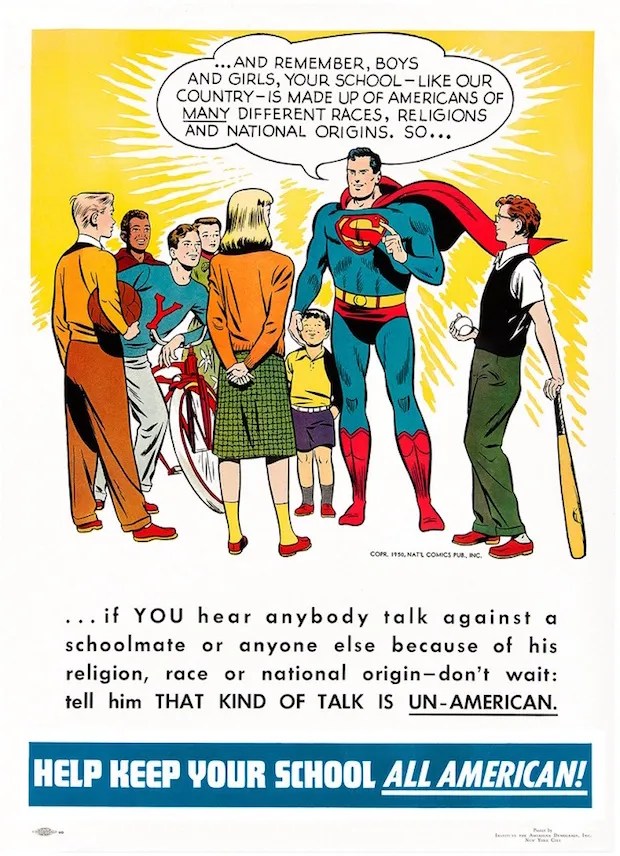
This poster was produced by D.C. Comics in 1949, and while some of the language is dated, the sentiment is the same.

 Ink Tea Stone Leaf
Leave a comment