Welcome back to my weekly series, Vocab 128, in which I sit down with pen and paper and write 128 words beginning with the same letter, in more or less the order that I think of them, before scanning the page and posting it here. The result is a flex of my vocabulary muscles, an exposure of my handwriting to the world, and perhaps an insight into the psychology of my word associations.
Generally, I avoid words that are merely alternate forms of other words, and when I think of such a word I generally default to the appropriate noun form. Proper nouns I exclude as a rule (but we’ll see how that goes once I get to X).
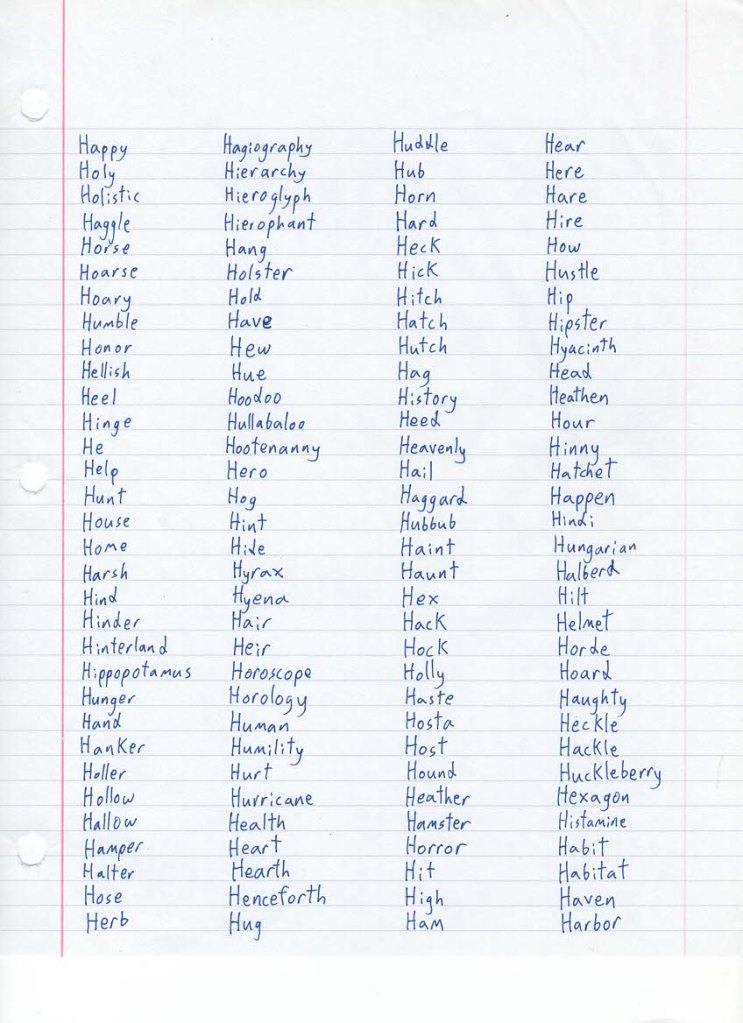
The dictionary claims that “haint” is merely a dialectical variation of “haunt,” but that’s just etymology again. The college professor who assigned me Toni Morrison’s Beloved taught me a lot more about that word.
This week’s definition from American Heritage Dictionary:
hi·er·o·phant (hīər-ə-fănt′, hīrə-, hī-ĕrə-fənt)
n.
1. An ancient Greek priest who interpreted sacred mysteries, especially the priest of the Eleusinian mysteries.
2. An interpreter of sacred mysteries or arcane knowledge.
3. One who explains or makes a commentary.
[Late Latin hierophanta, from Greek hierophantēs : hieros, holy; see eis- in the Appendix of Indo-European roots + -phantēs, one who shows (from phainein, phan-, to show; see bhā-1 in the Appendix of Indo-European roots).]

 Ink Tea Stone Leaf
Leave a comment