The idiom in the title of this post is first known in the English language from 1959, a surprisingly recent date given that the English have been picking literal cherries since at least the time of Henry VIII. It is an evocative metaphor, taken nowadays to mean that a person, when presented with a constellation of evidence that suggests a nuanced and complicated model of the world, has selected only the few pieces that suggest a simpler model. The cherry-picker leaves the inconvenient fruit on the tree, or otherwise tosses them aside, where they can be ignored.
I mention all this for no reason at all, except that I spent much of this morning picking cherries with Ariele, filling bowls and buckets up with the fruit of our backyard. We have two very productive cherry trees, and this is just about their ripest time of the season. Before we moved into this house, I’d never given much thought to the seasons of cherries, or what it was like to go out and actually pick them, and consequently I’d never had so much time to think about the idiom in the context of the action that inspired it. This is a wonderful thing: I love thinking about idioms, and I also love eating cherries and their various products.
If picking cherries in the conventional way were as ill-regarded as cherry-picking, the implications would be fascinating (as well as nauseating). If those who picked and packaged cherries on a commercial scale were to simply deliver all the fruit on their trees to the grocery stores as they found them, the average cherry consumer would be presented with the bare facts of the world: not all cherries are perfectly ripe and red, firm yet juicy, unblemished and uninhabited by insect larvae (more on that in a bit). If consumers valued this kind of stark realism in their produce, they would no doubt also be pleased by the massive increase in the supply of cherries, to say nothing of the corresponding decline in their price.
Consumers, however, do not visit the grocery store to reflect on the myriad forms of nature or the inevitability of decay and rebirth, but rather to buy cherries that aren’t disgusting. They’ll pay a premium to live in a world where cherries are beautiful and delicious, and so the pickers of cherries must cherry-pick the evidence that sustains that worldview. Nature can have what we have no use for, and the birds as always can eat the fruit that don’t pass muster.
When picking cherries, whether for profit or pleasure, there are a few things you learn to keep an eye out for. It’s easy to target the deepest reds and avoid the ones that have withered or molded on the branch, and to save the less-dark individuals to ripen and sweeten a little longer for next time. It’s often not until you get your hands on them, however, that you notice the squishy patches where, just underneath the surface, ripeness has begun to turn to rot. Without looking closely, you may also fail to notice whether your cherry has a tiny hole in its surface, the point of ingress for the young of the cherry fruit fly. It probably won’t kill you if you should happen to unwittingly eat one of these little white worms, but they don’t do the fruit any favors with regard to freshness or longevity. Finally, you’re best off leaving the ones that have already fallen on the ground alone. There are a lot of reasons they could be down there, and none of them tend to make the cherry more appetizing.
As selective as you must be for the cherries themselves, it also pays to be selective as to the time you pick. All pickers of cherries (as distinct from cherry-pickers) must be mindful of the season and the condition of individual trees. Those who are in it mostly for the leisure and not the pay will also be glad to select a warm, bright morning, when the sun shines gorgeously through the leaves and the leaves keep the ground comfortably shaded, while the objects of your search wave gently in the breeze. Picking fruit, cherries or otherwise, ought to be idyllic; otherwise all that minute examination and discrimination is just work.
If there’s one thing the human brain has evolved to do, it’s spot richly colored fruit against a green backdrop, and delight in pulling them down from the trees. It satisfies a deeply human need to gather beauty and sweetness and place them in neatly organized piles. Unfortunately, cherry trees can grow to be quite tall, and we humans (or at least Ariele and I) are not as adept at climbing them as some of our primate ancestors. A ladder can be helpful, but for the highest cherries we must be content to leave them unharvested, though they tantalize us with their irresistible redness.
Once the baskets are full and the picking of cherries is complete, the cherry-picking is not yet finished. Those we intend to eat on their own can be rinsed, dried, and stored in the fridge for our convenience. Those that are destined for jams and syrups and other homemade goodies, however, must be pitted and processed as quickly as possible. That’s why, hours after you’re back inside, you’ll find your hands and your kitchen counter stained red as you reexamine every little fruit you separate from stem and stone. Some don’t end up looking as perfect as you thought, and no matter how careful you were it’s almost inevitable you’ll encounter the little white worms again, hoping for whatever reason to sneak their way into a jar of preserves. There is, alas, no room in our visions of cherry flavored goodness for the insects that evolved specifically to feed on them. After coming this far, we can still afford to be picky.
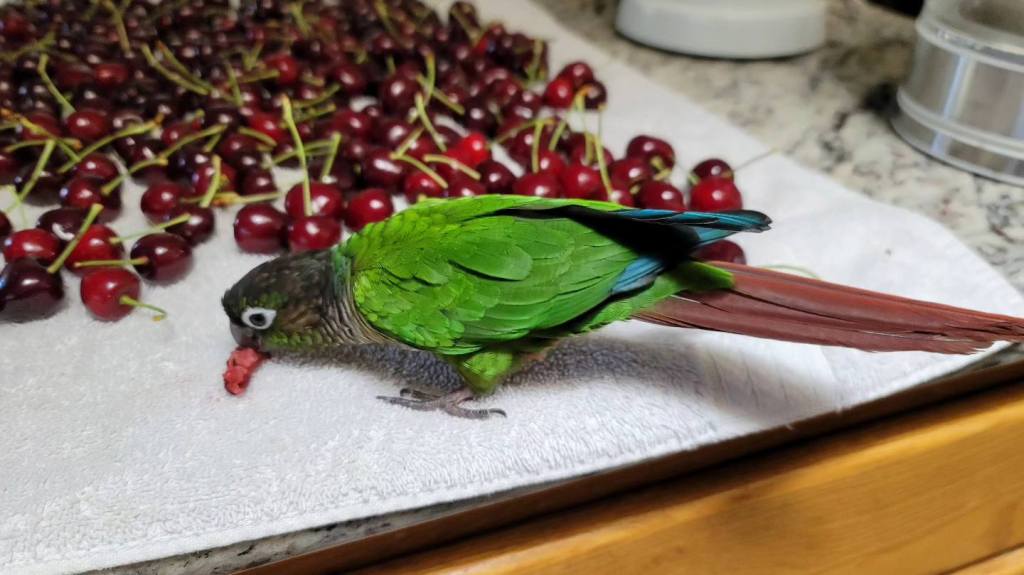
Even with the most exacting standards, however, you’re going to end up with a boatload of cherries. Though they are imperfect, they are ridiculously abundant. You will end up with more than you know what to do with, and the only logical thing to do is to share in your abundance of cherry goods. As it turns out, even the ones that do pass muster may be eaten by the birds.

 Ink Tea Stone Leaf
Leave a comment